RETIREMENT INCOME EDUCATION
How an IUL creates tax-free income.
An indexed universal life (IUL) policy is life insurance first. But structured well, its cash value can become a source of retirement income that arrives with no income tax. The trick is simple once you see it: you don't withdraw the money — you borrow against it.
How it works, in five steps
No jargon. This is the whole mechanism.
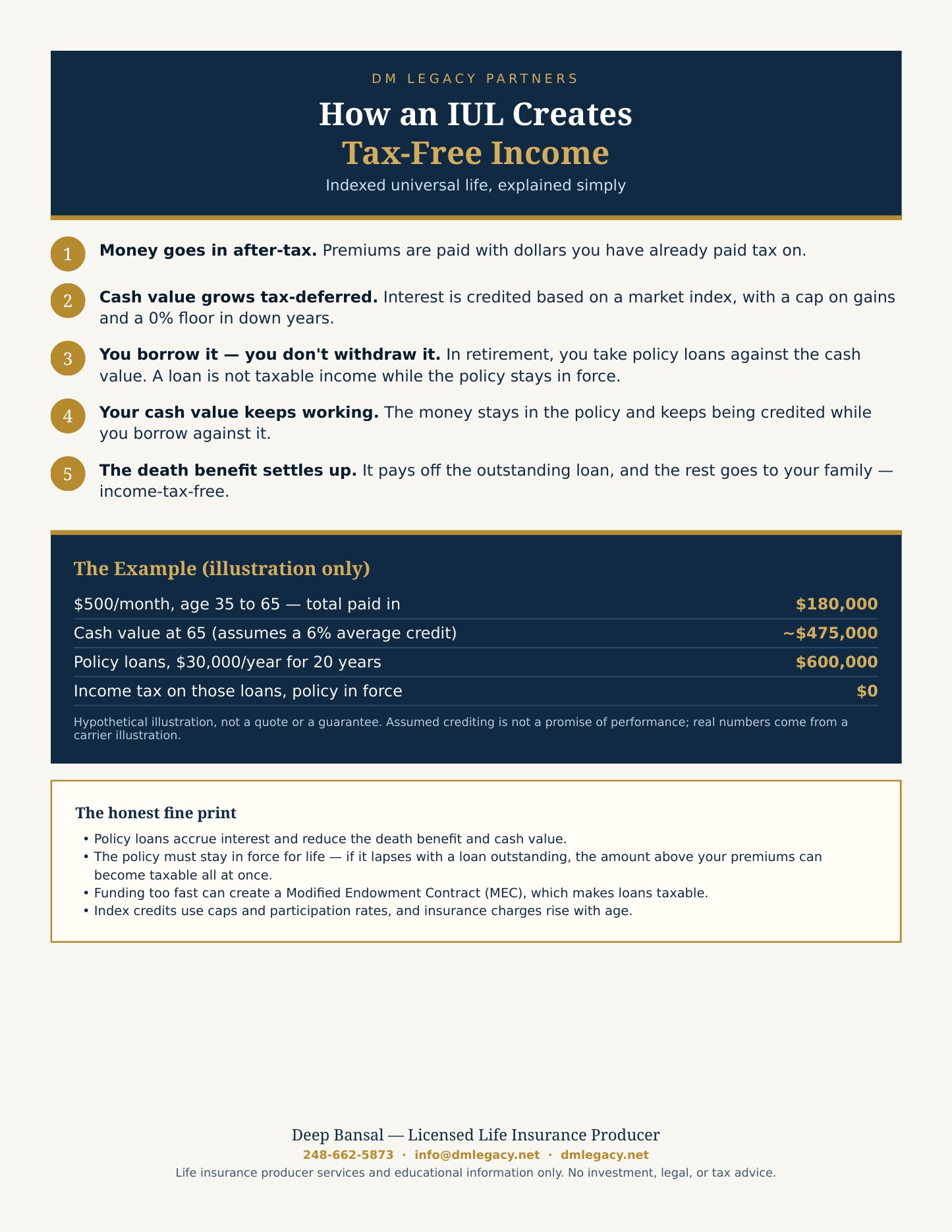
Money goes in after-tax
You pay premiums with dollars you've already paid tax on. There's no deduction going in — the tax benefit comes later, on the way out.
Cash value grows tax-deferred
Part of each premium builds cash value. Interest is credited based on a market index — with a cap on the gains and a 0% floor, so a down year in the market doesn't reduce your cash value. No tax is due on the growth along the way.
You borrow it — you don't withdraw it
In retirement, instead of making taxable withdrawals, you take policy loans against the cash value. Under the tax code, a loan is not income — so the money arrives with no income tax, as long as the policy stays in force.
Your cash value keeps working
The money you borrowed against never actually left the policy. The full cash value stays in place and keeps being credited while the loan is outstanding.
The death benefit settles up
When you pass, the income-tax-free death benefit first pays off the outstanding loan. Whatever remains goes to your family — also income-tax-free.
One example, with real-shaped numbers
A hypothetical illustration — not a quote, and not a guarantee. It shows the shape of the strategy; your numbers would come from a carrier illustration.
$180,000 paid in
$500 a month from age 35 to 65 — thirty years of premiums.
~$475,000 of cash value at 65
Assuming the cash value averages a 6% annual credit over those thirty years. That 6% is an illustration assumption, not a promise — index credits move with caps and participation rates.
$600,000 taken out, tax-free
Policy loans of $30,000 a year from 66 to 85 — twenty years of income, $0 in income tax while the policy stays in force.
The honest fine print: policy loans accrue interest and reduce the death benefit and cash value. The policy must stay in force for life — if it lapses with a loan outstanding, the amount above your premiums can become taxable all at once. Funding a policy too fast can make it a Modified Endowment Contract (MEC), which makes loans taxable. And insurance charges rise with age. An IUL is a long-term tool, not a shortcut — which is exactly why the details matter before you sign.
Take it with you
The one-page version of this guide — the same one I share with clients.
Want to see your own numbers?
Deep Bansal — Licensed Life Insurance Producer, DM Legacy Partners, Michigan. I offer insurance and retirement education, and I help families understand tools like indexed universal life — how they work, and where the fine print lives.
One free conversation. No pressure, no obligation — bring your questions.